
Geothermal energy is not only a technological or geological challenge. Above all, it is a challenge of creating, transferring, and capitalising on knowledge.
The energy transition depends on our ability to develop and deploy new technologies at scale. Whether geothermal energy, energy storage, hydrogen, carbon capture, or the digitalisation of infrastructure, the technical challenges are significant and the required investments substantial.
Among these technologies, geothermal energy occupies a unique position. It offers the opportunity to produce heat and, in some cases, electricity locally from a renewable and continuously available energy source. Its potential is considerable, both in Switzerland and around the world. Yet despite decades of research and development, geothermal energy is still in a phase of market expansion.
This raises a fundamental question: what truly enables a technology to move from innovation to a mature industry?
Experience shows that the success of a technology does not depend solely on its technical performance. Rather, it relies on a set of conditions that allow knowledge to grow, skills to spread, and projects to multiply.
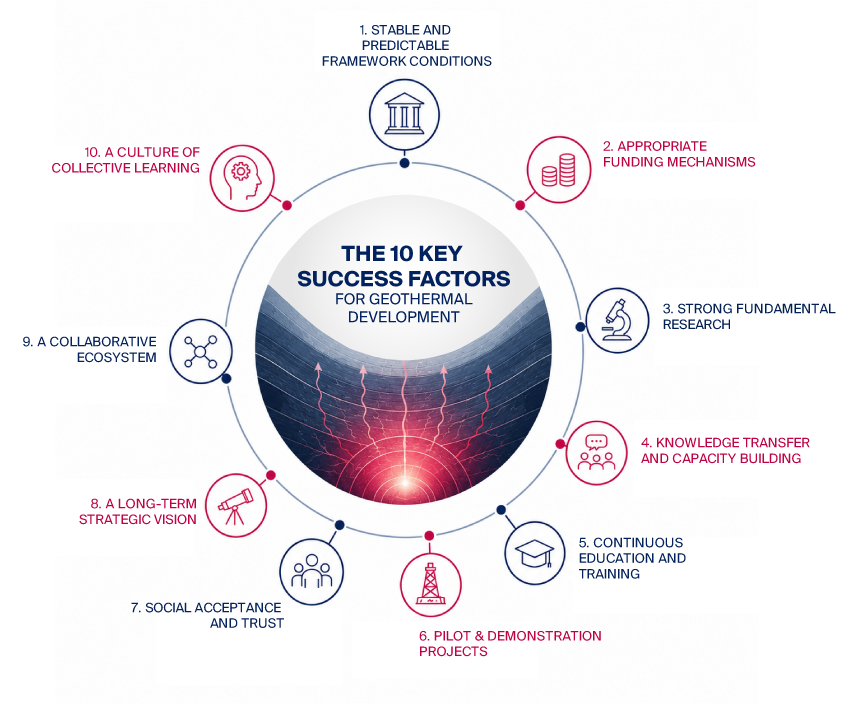
Drawing on experiences from Switzerland and abroad, ten key success factors emerge as particularly important for the development of geothermal energy.
1. Stable and Predictable Framework Conditions
The development of new technologies requires substantial investments over periods of many years, sometimes even decades.
Companies, investors, and project developers need a clear regulatory framework, transparent procedures, and consistent policy objectives. Regulatory uncertainty often represents a greater obstacle than the technical challenges themselves.
In the geothermal sector, public support mechanisms play a crucial role in reducing risks during the early stages of project development.
2. Appropriate funding mechanisms
Every emerging technology goes through a phase where risks are high and business models remain uncertain.
Geothermal energy illustrates this reality particularly well. Exploration and drilling costs are significant and must be incurred before the actual performance of a reservoir is known.
Appropriate funding mechanisms are therefore needed to support the different stages of development, from research and demonstration projects to commercial deployment.
The transition from research to market often remains the most challenging step.
3. Strong fundamental research
Tomorrow’s technologies are built on the scientific knowledge generated today.
Recent advances in deep geothermal energy, Enhanced Geothermal Systems (EGS), Advanced Geothermal Systems (AGS), subsurface characterisation, and numerical modelling are the result of decades of fundamental research.
Investment in research does not always produce immediate results. However, it lays the foundation for the innovations of the future.
4. Knowledge transfer and capacity building
Generating knowledge is one thing. Sharing it is another.
Innovation progresses more rapidly when experiences are exchanged between universities, engineering consultancies, companies, public authorities, and project developers.
In geothermal energy, every project and every well provides a valuable learning opportunity. The data collected, the experience gained, the challenges encountered, and the solutions developed all contribute significantly to expanding knowledge across the sector.
Knowledge-sharing programmes help preserve this expertise, structure it, and make it available for future projects. In doing so, they prevent valuable lessons from being lost and reduce the need to solve the same challenges repeatedly.
5. Continuous education and training
Technologies evolve rapidly. Skills must evolve just as quickly.
The development of geothermal energy requires geologists, hydrogeologists, drilling engineers, energy specialists, modellers, environmental experts, and communication professionals capable of working together across disciplines.
Initial education alone is no longer sufficient. Professionals must continuously update their knowledge to keep pace with technological and regulatory developments.
Today, the shortage of qualified professionals is one of the main barriers to the growth of many energy sectors.
6. Pilot and demonstration projects
No technology can be developed solely on the basis of theoretical models.
Pilot projects allow concepts to be tested under real-world conditions, reduce technical uncertainties, and progressively improve solutions.
In geothermal energy, every project generates new insights into subsurface behaviour, system performance, and implementation strategies.
Demonstration projects also play a vital role in building confidence among investors, authorities, and the public.
7. Social acceptance and trust
The success of a technology also depends on its acceptance by society.
Issues related to environmental impacts, risks, land use, and public concerns must be addressed from the earliest stages of project development.
Experience shows that transparency, dialogue, and stakeholder engagement are essential success factors.
Trust is not built solely through technical arguments. It is built through open and credible communication.
8. A long-term strategic vision
Energy infrastructure is developed and operated over decades.
The geothermal projects being developed today may contribute to energy supply for fifty years or more. Such a perspective requires long-term thinking and continuity in public policy.
Countries that successfully establish new technologies are often those that maintain a clear and consistent strategy despite political and economic cycles.
9. A collaborative ecosystem
Major innovations rarely emerge in isolation.
Geothermal energy brings together expertise in research, geology, engineering, drilling, energy systems, finance, communication, administration, and operations.
Strong networks between these actors accelerate learning, foster innovation, and reduce development risks.
Innovation clusters and professional associations often play a central role in creating these connections.
10. A culture of collective learning
No innovation can progress without the ability to learn from experience.
Pioneering projects inevitably involve uncertainty. Some achieve rapid success, while others face difficulties or require adaptation.
The key factor is not the absence of mistakes. It is the ability to transform experience into knowledge and to make that knowledge available for future projects.
This principle is particularly relevant in geothermal energy, where every project contributes to a better understanding of the subsurface and helps progressively reduce uncertainty for the entire sector.
Conclusion
Geothermal energy is often viewed as a geological or technological challenge. In reality, its development depends just as much on human, organisational, and institutional factors.
The ten success factors presented in this article demonstrate that innovation is not simply the result of an invention or a technical breakthrough. Above all, it depends on the ability of an ecosystem to create, share, and build upon knowledge.
At a time when the energy transition requires the rapid deployment of new solutions, this dimension deserves particular attention. The most valuable resources are not found only beneath our feet. They are also found in the skills, experience, and collective learning capacity of the people involved.
The future of geothermal energy will certainly be shaped by further technological advances. But it will depend just as much on our collective ability to create the conditions necessary for its successful development.



Leave A Comment